Secondary English currently finds itself in limbo. Publication of the Curriculum and Assessment Review (CAR) final report last year alerted us to coming changes but beyond broad areas of focus, it’s difficult to know exactly what they will look like. With media, drama, language study and oracy back on the agenda, there are reasons to be hopeful, as we were in our initial blog response immediately after the CAR’s release. Now we’re not so sure.
We still think significant, positive change can emerge, but we also worry that constraints might limit what can be achieved. There are lots of qualifications in the CAR and the government response to it was cautious and conservative in tone. School English has been so twisted out of shape in the past decade or so by exam pressures, the imposition of ill-fitting pedagogies, the push to develop sequential curricula and inflexible ideas about cultural capital that it will take a bold, knowledgeable and confident curriculum drafter to point out to the DFE that what has been forced on English teams in recent years simply won’t do. The CAR stressed that it was about evolution not revolution, but it’s hard to see how English in its present state can evolve in a healthy direction – while it’s all too easy to see how it could doom-spiral towards an extinction event. Something more radical is called for.
We find ourselves, then, in a moment of concerned optimism. We are convinced that things can get better, but we’re worried that they might not. To that end, as a team, we have set about writing a series of short think pieces about different aspects of English, focusing on what we believe different areas of the subject can offer if they are approached in a sensible way, with a full understanding of the possibilities available. We've focused on areas that have been neglected for the past decade or so and each piece is individually authored, so they take different approaches. Some engage directly with the possibilities and limitations of the CAR, others set out a vision for a particular curriculum area. What each has in common is a belief that English can and should be the most enjoyable, enriching and valued of all the subjects for large numbers of students. I imagine that was the case for most readers of this blog – so collectively we know how it can be done!
Before moving on to individual pieces, it’s worth reflecting on some overarching aspects of the CAR that need careful thought for any meaningful change to take root. They’re given prominence in the CAR’s overview of all subjects but need additional interpretation in relation to English.
Assessment
There was disappointingly little in the CAR about assessment and English, a real issue given the levels of dissatisfaction with GCSEs, particularly English Language. If the assessment of GCSEs remains as it is, it’s difficult to conceive of this dissatisfaction being alleviated. Thought needs to be given to the pernicious effects of the Assessment Objectives on current ways of teaching English. They’ve led to the atomisation of the subject and an excessive focus on the smaller component parts of reading and writing at the expense of engagement at a whole text level. Ofqual needs to give Awarding Bodies the freedom to develop assessment criteria that they are confident will work for young people and for the subject. To us, this means moving to best-fit assessment descriptors that start with an evaluation of overall quality of response. The English Language qualification also is in desperate need of actual content. One easy solution is to give language study the prominence it deserves.
Sequencing
The CAR is clear that it expects programmes of study to be carefully sequenced. This poses problems for a subject like English, which often resists being built up from component parts, instead starting with a concept of the whole (the whole of what’s been read; an entire piece of writing; a complete utterance, etc.). There is a recognition that ‘sequences of learning will vary between subject disciplines’ and that they ‘would look different in subjects that are largely hierarchical in nature to those that are largely cumulative’, which gives some hope for English. While no subjects are named, we assume that English is intended to be seen as ‘cumulative’, so allowing for a curriculum that returns constantly to key aspects of study (in relation to the novel, poetry, drama, creative writing etc.), rather than ticking them off one by one or breaking them up into decontextualised parts.
Oak National
While the CAR is at pains to promote the importance of teacher autonomy, it also mentions Oak National several times as having a role in developing support materials. Given its links to government, it’s easy to envisage a situation in which schools feel compelled to use Oak’s resources to make sure that their curriculum is deemed acceptable by Ofsted. Whatever the quality of Oak’s resources – and we’ve been worried in the past about its quality in relation to English – it will be deemed suitably sequenced and rigorous. It is crucial that Oak National doesn’t become another non-statutory enforcement tool used to compel schools to behave in ways that ultimately run counter to their best instincts, the interests of their students and the future health of the subject.
Specificity
Specificity is mentioned 34 times in the CAR. For English, there is a call for ‘more clarity and specificity at Key Stage 3’ in order to ‘improve coherence between primary and secondary’. We recognise the need for greater links between the key stages, but we’re not sure that specificity is the real issue. The problem is that secondary curricula are often built from GCSE backwards. Students then only do what’s required of them at GCSE, meaning an absence for many students of staples of the subject, such as writing poetry, contemporary drama, language study, and so on. If teachers are given broad areas that must be covered across key stages (such as the aforementioned writing poetry, studying contemporary drama and language study), and freed from the tyranny of GCSE, then they can draw on their own experience to provide suitable content for their students.
Diversity
The CAR is at pains to stress the importance of a curriculum that reflects the diversity of modern Britain (though, of course, this is a curriculum for students in England only). However, it seems remarkably naive in envisaging how this might happen, commenting on GCSE Literature:
Alongside the continued study of Shakespeare and 19th century literature, students should have the opportunity to explore a more diverse array of authors from the British Isles without adding to the mandatory volume of content.
Under this formulation, GCSE English Literature is likely to remain pretty much as it is. It’s to be hoped that the Awarding Bodies are given the freedom to interpret any remit imaginatively, so that a diverse curriculum becomes a reality for all students. To make this easier, we hope that the requirement that the authors come exclusively from the British Isles is reviewed.
We have our own ideas at EMC about what an English curriculum might look like and how it might best be taught. We wouldn’t presume that this would coincide with how all English teachers view the curriculum, nor would we want that to be the case. Whatever emerges once the programme of study has been drafted, it’s vital that it leaves space for different schools to interpret it in different ways. We’ve lived through a period in which English teachers in many schools have felt compelled to adapt their teaching – in terms of content and pedagogy – in ways out of step with the subject’s traditions and, indeed, with how the effective study of Language and Literature works. We are worried that this might remain the case, so offer these pieces as a provocation to policy makers and curriculum drafters and, in some pieces, as a helpful steer for English teachers in their thinking about change. This is what we believe effective English can and should look like.
Click on the link below to read the 'think piece' of your choice:
The Future of Language in KS3 and KS4 English
Standard(ised) English – an EMC think piece
Talk in the New National Curriculum
It's Time to Embrace Drama in English
Against Mandatory Diagnostic Testing
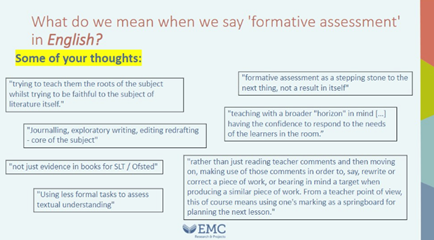
Curriculum reform and getting formative assessment right